
Sustainable Compassion: Setting Healthy Boundaries in Clinical Practice by Dean Attwood
In this insightful piece, Dean explores the silent burden of compassion fatigue that many dedicated practitioners experience when helping patients navigate pain, vulnerability, and recovery. He highlights the vital importance of establishing healthy emotional and business boundaries, reminding professionals that sustainable care means guiding patients without unconsciously carrying their emotional weight.
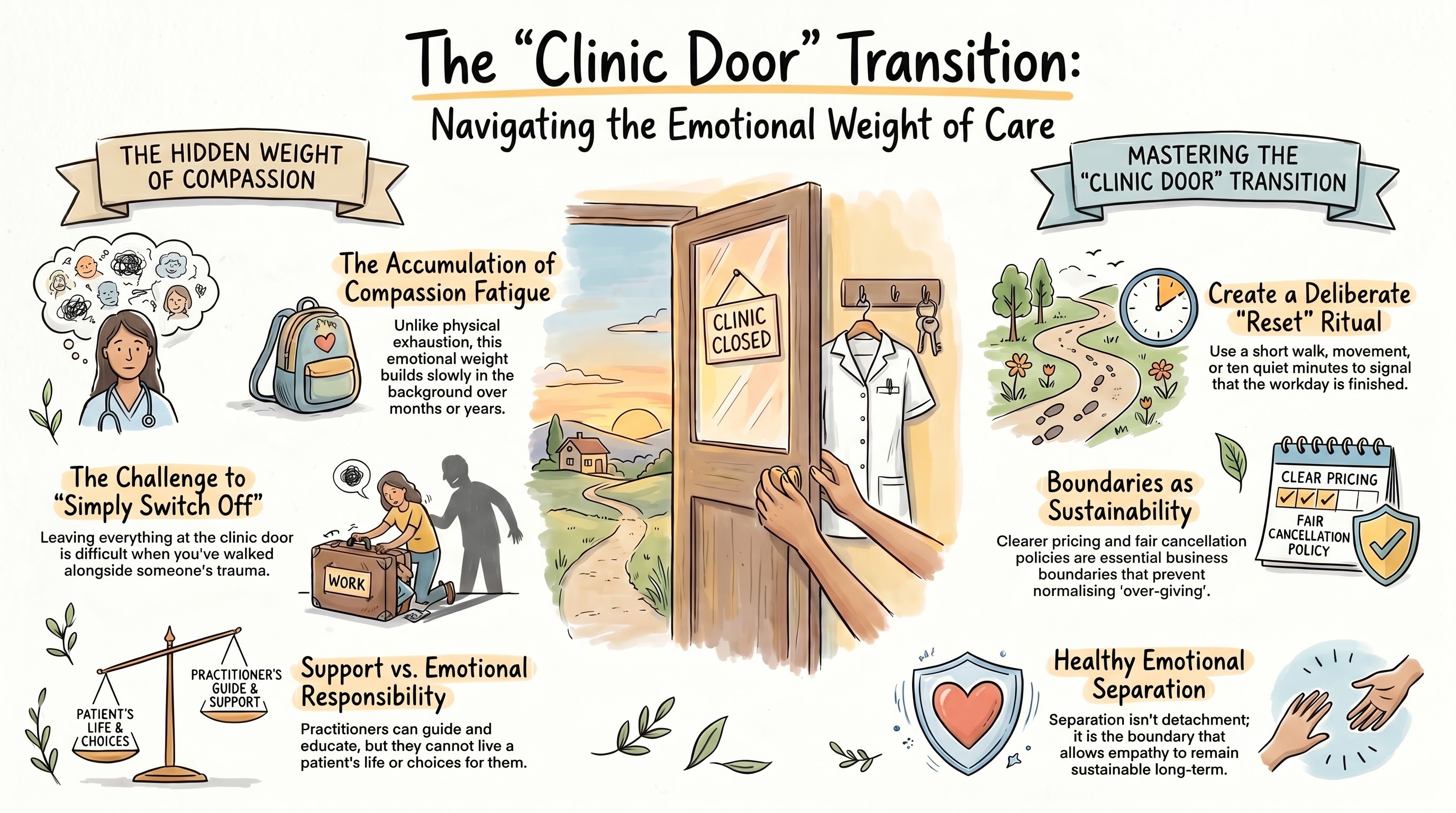
Mastering the 'Clinic Door' transition: Essential steps for practitioners to navigate the emotional weight of care, create deliberate reset rituals, and build sustainable boundaries.
Many people outside therapy, healthcare and wellbeing professions often underestimate the level of emotional and mental involvement that can develop between practitioner and patient over time.
As practitioners, we are not simply listening to symptoms or following treatment plans. We are often walking alongside people through pain, uncertainty, frustration, fear and change. We think about patients before sessions, during sessions and often long afterwards too. We consider outcomes, reactions, setbacks, progress, resistance and how certain conversations or treatments may emotionally and physiologically affect the person sitting in front of us.
Whether the work is physical or psychological, many practitioners are often thinking several steps ahead. Trying to guide, support, protect, encourage and help people safely navigate difficult parts of their lives. Over time, patients can quietly begin occupying space in our minds well beyond the treatment room itself.
That is one of the reasons compassion fatigue can become a real challenge.
Not because practitioners are weak. Not because they “care too much.” But because there is a very real human cost to continually walking alongside pain, pressure and vulnerability every single day.
Most people experience stress, pressure and uncertainty within their work and personal lives at times, especially in the current climate. However, professions built around caring for, supporting and guiding other people often carry an additional emotional layer that can be easy to overlook.
When your work regularly involves helping people navigate pain, vulnerability, recovery and change, it can become a challenge to simply “switch off” and leave everything at the clinic door.
The challenging part is that compassion fatigue rarely arrives loudly. Most practitioners simply keep going.
Because unlike physical exhaustion, compassion fatigue often builds slowly in the background over time. Many practitioners continue showing up, caring deeply and supporting others long before they fully recognise the emotional weight they themselves have been carrying for months, or sometimes even years.
Somewhere along the way, many caring professionals started accepting emotional exhaustion as simply part of being good at the job. The reality is, many practitioners simply learned to keep going. To stay professional. To continue showing up for others, whilst quietly carrying the impact of the work themselves.
In many environments, the psychological impact of the work itself is still rarely spoken about openly. Many practitioners continue functioning highly on the outside, whilst privately feeling emotionally drained, detached or exhausted underneath the surface.
For practitioners working within clinics or teams, there is at least the potential for shared understanding, peer support and opportunities to decompress with others who understand the pressures of the role. However, for many self-employed or solo practitioners, this pressure is often carried almost entirely alone.
There is no team meeting afterwards.
No colleague to offload to between sessions.
No shared responsibility at the end of the day.
Just the next patient.
The next concern.
The next challenge.
And over time, constantly carrying both patient and business responsibilities can begin to wear us down.
One of the most important things practitioners can learn is the difference between supporting somebody… and becoming emotionally responsible for them.
As practitioners, we can guide, support, educate, encourage and create opportunities for change. But we cannot live people’s lives for them. We cannot make their decisions for them. Ultimately, people still must make their own choices outside of the treatment room.
Because the reality is…change is hard.
Many people naturally resist change, especially when it involves confronting painful patterns, uncomfortable truths, destructive habits or deeper wounds that may have existed for years. One of the hardest parts of personal growth is often not understanding what needs to change… but having the courage to make different choices consistently afterwards.
This is something I often gently reinforce with patients myself. Sometimes even humorously:
“I’m not here to tell you what to do… here’s a suggestion.”
Because the role is not to command people or force change onto them. It is to help unlock a door, create awareness, offer guidance and help somebody begin seeing a possible path forwards. But ultimately, it is still their journey, their responsibility and their choices outside of the treatment room that shape their outcome.
Although it may sound simple, this also creates an important emotional boundary for practitioners. It subtly hands responsibility back to the patient. It respects autonomy. It reduces over-identification and helps stop practitioners unconsciously carrying responsibility for outcomes that ultimately belong to somebody else’s life and their choices.
This is not detachment.
This is healthy emotional separation.
Healthy boundaries are not a reduction in care. They are often what allow care, compassion and empathy to remain sustainable long term.
I think part of the problem is that many practitioners were taught how to care for others… but not necessarily how to separate themselves from the work afterwards.
This work was never supposed to be about emotionally rescuing people. It is about guiding, supporting, educating and helping create opportunities for change.
One of the dangers within caring professions is that practitioners can slowly begin unconsciously carrying responsibility for changing people, fixing outcomes or owning somebody else’s pain and their journey. Over time, that becomes emotionally exhausting very quickly.
Alongside caring for patients, supporting recovery and holding emotional space for others, many practitioners are also trying to navigate the realities of self-employment or business ownership.
Of course, uncertainty, financial pressure and responsibility are not unique to caring professions. Many self-employed people and small business owners experience these pressures a lot of the time. However, within therapy, healthcare and wellbeing professions, these pressures can sometimes become deeply intertwined with the caring nature of the work itself.
Caring professions often emotionally blur the line between helping people and valuing ourselves properly.
Because many practitioners genuinely care. We want to help. We understand pain, struggle and vulnerability. But over time, that empathy can sometimes begin influencing business decisions in ways that are not always sustainable.
Cancellation fees become uncomfortable.
Pricing feels personal.
Boundaries feel guilty.
Over-giving becomes normalised.
And slowly, many practitioners begin carrying not only the responsibility of caring for people… but also the cost of undervaluing themselves in the process.
And much like compassion fatigue itself, this pressure rarely arrives as one dramatic moment. It is usually the slow accumulation of constant low-level uncertainty sitting in the background of everyday life.
The difficult part is that many practitioners never fully switch off from either role.
Even whilst helping patients, part of the mind is often still problem-solving, forecasting, planning or worrying quietly underneath the surface.
Over time, this can leave people feeling mentally empty long before they physically stop working.
This is why reset and separation become so important within caring professions. Because sustainable caring often requires learning how to step out of the psychological pressure of the role, without losing compassion in the process.
Not becoming cold.
Not caring less.
Not building walls.
The goal is not to care less.
The goal is to carry the work differently.
For many practitioners, one of the most important shifts is learning that supporting somebody does not mean emotionally carrying every outcome for them afterwards. We can care deeply about people, whilst still recognising that their healing, choices and progress cannot sit entirely on our shoulders once the session ends.
Sometimes the healthiest thing a practitioner can do is create clearer boundaries between work and home.
That may be:
- a short walk before driving home
- ten quiet minutes between patients
- movement after work
- reflective journaling
- talking honestly with another practitioner
- or simply creating a deliberate moment where the nervous system is allowed to recognise: “The working day is finished.”
Not because the practitioner does not care.
But because constantly staying emotionally switched on eventually becomes unsustainable.
The same applies to the business side of the work.
Sometimes support comes from personal boundaries.
Sometimes it comes from business boundaries too.
Clearer pricing.
Fair cancellation policies.
More realistic availability.
Healthier expectations around over-giving.
Not as punishment.
Not as greed.
But as sustainability.
And for solo practitioners especially, support becomes incredibly important. Not because they are weak or incapable, but because no one is designed to carry everything alone for long periods of time. We all need space to offload and reset.
Sometimes the most important thing is simply having somebody else who understands the weight of the role.
A trusted colleague.
A supervisor.
A peer group.
A professional community.
An honest conversation.
Because caring professions were never really designed to be carried in silence.
Perhaps the real shift is recognising that caring deeply for people and constantly carrying them are not the same thing.
You can support people.
Guide people.
Care deeply about the work you do.
And not lose yourself in the process.
Seeing what many caring professionals and teams quietly carry is one of the reasons my colleague and I created Integral Workplace Wellness — to help people and organisations better support wellbeing, pressure and more sustainable ways of operating.
If this article resonates with you, your team or your workplace, please feel free to reach out for support.
About the Author: Dean Attwood

Dean Attwood is a Mindset and Performance Coach and an Anxiety Expert. He is the Owner and Director of Integral Workplace Wellness, a mental health support and training company that specialises in staff and business support for SMEs. Alongside Bel Hardman, Dean runs this heart-centred, people-focused company with professionalism and integrity at its core. Their mission is to help organisations put workplace wellness first, benefiting both valued staff members and the business as a whole.
