
Two Years of Clinical Experience with DEEP OSCILLATION® in Multiple Sclerosis Rehabilitation: Treating the Patient, Not the Diagnosis
Drawing from two years of working alongside individuals with Multiple Sclerosis, the author reflects on how clinical practice evolved toward treating living tissue presentation, using Deep Oscillation as a gentle extension of the therapist’s hands.
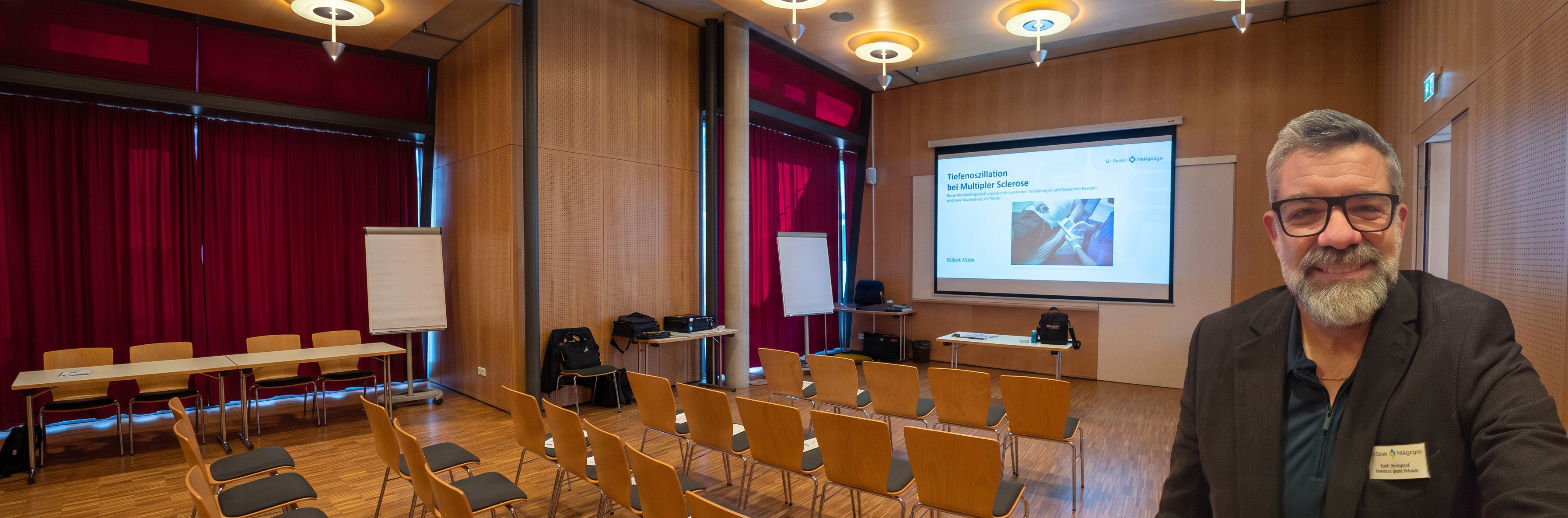
Department Head of 9 specialists at Dr. Becker PhysioGym, Kiliani-Klinik, Bad Windsheim, Germany
Clinical Background & How It Started
I work as a Specialist Therapist in Therapeutic Massage and Physical Agents (Masseur und Medizinischer Bademeister) and Team Leader in Physical Therapy at the Dr. Becker Kiliani-Klinik in Bad Windsheim, Germany. Our patients with Multiple Sclerosis (MS) participate in a comprehensive, multidisciplinary rehabilitation programme. For this reason, the experiences described here should not be interpreted as evidence for DEEP OSCILLATION® as an isolated treatment for MS. Rather, they represent approximately two years of clinical observations made while integrating this modality as one component of our holistic neurorehabilitation care pathway.
Around four years ago, several water-based treatments previously used in our department—including contrast baths and four-cell baths with electrotherapy—were discontinued. This left our physical therapy team of nine specialists asking a crucial practical question: how could we fill the therapeutic gap left by these modalities, particularly for our neurological patients?
At the end of 2024, I was introduced to Deep Oscillation during a continuing education course on electrotherapy. I immediately recognised that the method could hold a valuable place in our department. Our team works extensively with manual lymphatic drainage, therapeutic massage, thermal applications, electrotherapy, and connective tissue techniques. Over time, I stopped seeing Deep Oscillation simply as another electrotherapy device. For me, it became a true extension of the therapist's hands
The Patient Who Changed My Perspective
One of my first patients with MS was a gentleman between 35 and 45 years old who used a wheelchair and reported that walking had become almost impossible during the preceding six months. He received two approximately 20-minute Deep Oscillation sessions per week, primarily treating both lower extremities simultaneously.
After approximately two weeks of therapy, the patient shared with genuine joy that during his active physiotherapy session, he had managed to walk several steps again. He personally believed that Deep Oscillation had made an important contribution to this breakthrough.
Naturally, as clinicians, we cannot attribute such progress to Deep Oscillation alone, as the patient was simultaneously participating in a full multidisciplinary rehabilitation programme. But it sparked a vital question within our team: what were we observing, and how could we harness this biophysical interaction most effectively for our patients?
MS Has Many Faces: Moving Beyond Static Protocols
When I first started using the equipment, I followed a predefined standard preset for MS, applying approximately 200 Hz for 20 minutes. However, daily clinical practice quickly taught me that a rigid, static protocol was insufficient. Multiple Sclerosis is highly heterogeneous: one patient presents with acute pain, another with fluid congestion or dependent oedema, another with marked muscle spasticity, and another with sensory impairment. Furthermore, symptoms are rarely symmetrical—some patients present with bilateral leg involvement, while others experience primary difficulty in a single limb.
Rather than treating a disease label, effective neurorehabilitation requires assessing what the living tissue is experiencing on that specific day ("treating the body, not the diagnosis"):
- High Frequencies (150–200 Hz): Applied at the beginning of sessions when acute pain, local tissue inflammation, or sensory hypersensitivity is present. Higher frequencies provide a clinically conservative strategy with lower mechanical perception, gently soothing overstimulated pain pathways.
- Low Frequencies (15–28 Hz): Incorporated when localised fluid congestion, post-traumatic swelling, or stagnant interstitial oedema is present to assist local fluid reabsorption.
- Medium Frequencies (28–85 Hz): Utilised towards the middle and end of sessions (reserving the final 3 minutes for 85 Hz) to encourage muscle relaxation, mobilise fascial tissue, and ease spasticity.
Key Clinical Observations Across Two Years
- The 'Therapeutic Window': Combining Deep Oscillation with manual techniques effectively eases spasticity and muscle hypertonia, opening a crucial 'therapeutic window' lasting from 30 minutes to 3 hours. When active physiotherapy, transfer practice, or gait training immediately follows, patients achieve significantly better active range of motion, easier movement, and improved stride quality.
- Sensory Peripheral Re-engagement: In several patients presenting with marked sensory loss or numbness in the lower extremities, applying low-intensity electrostatic impulses elicited a temporary, gentle tingling sensation in previously unresponsive areas. We explicitly do not claim nerve regeneration, but rather a temporary sensory re-engagement that patients find deeply encouraging.
- Non-Compressive Fluid Clearing: For MS patients who develop secondary dependent oedema or post-traumatic swelling, Deep Oscillation supports the gentle movement of stagnant fluid into initial lymphatics without subjecting fragile skin or spastic muscles to thermal heat or aggressive physical compression.
Mechanobiological Rationale & Supporting Research
- Mohapatra et al. (2024) [1]: Observed that applying Deep Oscillation across high-to-medium frequencies was associated with reductions in muscle spasticity and improvements in active and passive range of motion.
- Boisnic & Branchet (2013) [2]: Reported that electrostatic oscillating fields downregulate pro-inflammatory Interleukin-8 (IL-8) cytokines and quiet overstimulated TRPV1 pain receptors in an ex vivo human skin model.
- Jahr, Schoppe, & Reisshauer (2008) [3]: Demonstrated significant reductions in tissue swelling and local pain through low-intensity electrostatic field stimulation in secondary breast lymphoedema.
- Villalba-Meneses et al. (2024) [4]: Evaluated Deep Oscillation therapy in a systematic review on lumbar pain syndrome, reporting favorable biomechanical and movement outcomes.
- Oestervemb et al. (2025) [5]: Reported enhanced early rehabilitation outcomes when Deep Oscillation was integrated following anterior cruciate ligament (ACL) reconstruction in a randomized controlled trial
The Hands Still Matter: Individualised Application
Within our own team, I have observed different ways of using the equipment. Some therapists prefer using the handheld applicator, while others prefer applying therapy through vinyl gloves. For me, glove application is irreplaceable: it allows me to continuously adapt my manual technique, pressure, and direction according to real-time tissue response and patient feedback.
Equipment is only as effective as the clinical reasoning behind it. Deep Oscillation does not replace the human touch—it functions as an extension of the therapist's hands, blending biophysical interaction with sensitive manual palpation
From Observation to Systematic Documentation (2027 Project)
There are clear limitations to our initial two-year experience: we had no control group, did not consistently record standardised objective measurements before and after every session, and our patients received multiple rehabilitation interventions simultaneously. For these reasons, we do not claim that Deep Oscillation treats Multiple Sclerosis or acts as an isolated solution.
What we do have is two years of rich clinical observations that generate vital questions for future research. From January 2027, together with our neurology colleagues at the Dr. Becker Kiliani-Klinik, we plan to begin documenting outcomes systematically. We aim to measure, document, and understand:
- Symptom Stratification: Identifying which specific symptom profiles (spasticity, pain, sensory loss, fluid congestion) show the most pronounced response.
- Duration of Response: Evaluating how long functional improvements, pain relief, and spasticity reduction persist post-treatment.
- Objective Metrics: Using goniometry, algometry, and functional mobility scores to quantify changes objectively.
- The 'Therapeutic Window': Measuring whether administering Deep Oscillation immediately prior to active exercise optimises functional gait training and physical therapy gains.
Conclusion
After approximately two years of integrating Deep Oscillation into neurorehabilitation, my most important lesson has not been discovering a single preset protocol for Multiple Sclerosis. It has been understanding that the patient—and their living tissue presentation on the day—must remain at the absolute centre of treatment.
Deep Oscillation does not replace active physiotherapy, exercise, or multidisciplinary care. Rather, it serves as a safe, pressure-free, and highly effective extension of the therapist's hands.
Scientific References
- Mohapatra, A., Pattnaik, M., & Mohanty, P. (2024). The Impact of Myofascial Release Therapy and Deep Oscillation Therapy on Hamstring Muscle Length and Tone in Children with Spastic Cerebral Palsy: A Comparative Study. Indian Journal of Physiotherapy & Occupational Therapy, 18(1), 7-15. DOI: 10.37506/ktz3jj23
- Boisnic, S., & Branchet, M. C. (2013). Anti-inflammatory and draining effect of the Deep Oscillation device tested clinically and on a model of human skin maintained in survival condition. European Journal of Dermatology, 23(1), 59-63. PubMed ID: 23420030
- Jahr, S., Schoppe, B., & Reisshauer, A. (2008). Effect of treatment with low-intensity and extremely low-frequency electrostatic fields (Deep Oscillation) on breast tissue and pain in patients with secondary breast lymphoedema. Journal of Rehabilitation Medicine, 40(8), 645-650. DOI: 10.2340/16501977-0225 | PubMed ID: 18802611
- Villalba-Meneses, F., et al. (2024). Evaluation of deep oscillation therapy for the treatment of lumbar pain syndrome using motion capture systems: a systematic review. Journal of Bodywork and Movement Therapies, 38, 180-190. DOI: 10.1016/j.jbmt.2024.01.010 | PubMed ID: 38309858
- Oestervemb, K., et al. (2025). Deep oscillation therapy enhances early rehabilitation after ACL reconstruction: a randomized controlled trial. Journal of Rehabilitation Medicine, 57. DOI: 10.2340/jrm.v57.44416 | PubMed ID: 39832101
