
Tissue-Centred Scar Care and DEEP OSCILLATION®
Supporting Recovery Across Every Stage of Tissue Healing
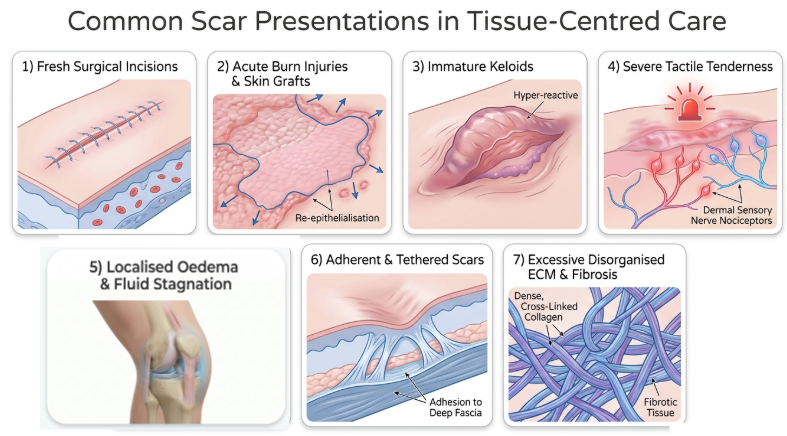
- Fresh Surgical Incisions (stitches or staples in place) [6]
- Acute Burn Injuries & Fresh Skin Grafts [3]
- Newly Forming & Hyper-Reactive Immature Keloids [4]
- Scars with Severe Tactile Tenderness or Burning Pain [1, 6]
- Scars with Localised Oedema & Fluid Stagnation [5, 6]
- Adherent & Tethered Scars [4, 7]
- Scars with Excessive, Disorganised Extracellular Matrix (ECM) & Fibrosis [4, 7]
Clinical Comment: Dr Anne Williams, Lymphoedema Nurse Consultant & MLD Therapist (Esklymphology)
I find Deep Oscillation extremely helpful with clients who have problems with deeper scar tissue after breast cancer treatment; particularly where there is persistent fibrosis after radiotherapy, and chronic breast lymphoedema. The scars on the skin at the axilla or breast area might be fairly small and have healed well. However, there is often scar tissue deeper within the breast which responds very well to Deep Oscillation and scar therapy.
.png)
Hypersensitive State (Acute & Inflamed)
- Presentation: Fresh surgical incisions (stitches or staples in place) [6], acute burns, skin grafts [3], immature keloids [4], or severe tactile pain [1, 6].
- Clinical Goal: Rapid sensory comfort, pain modulation, and gentle fluid clearance [1, 6].
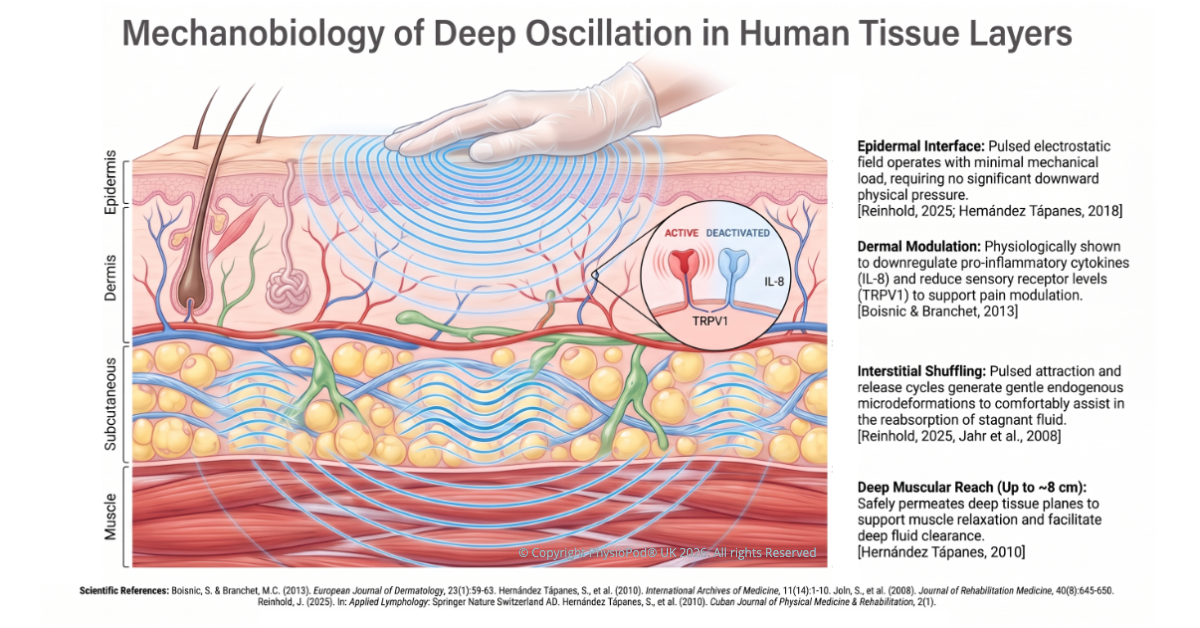
- Biophysical Action: Downregulates pro-inflammatory IL-8 cytokines and quiets hyperactive TRPV1 sensory pain receptors [1], accelerating fluid reabsorption over delicate suture lines or sterile barriers with zero pressure [4, 6].
Congested State (Puffy & Fluid-Laden)
- Presentation: Sub-acute scar margins surrounded by persistent post-operative swelling, boggy fluid entrapment, localised oedema, and deep tissue tightness [5, 6].
- Clinical Goal: Interstitial fluid clearing, reduced tissue tightness, and restored softness [5, 7].
- Biophysical Action: Alternating electrostatic attraction and release cycles induce gentle endogenous microdeformations that keep initial lymphatics open to clear trapped oedema [5, 7].
Indurated State (Hard & Tethered)
- Presentation: Mature or chronic scars bound to underlying fascial planes, adherent scars, dense collagen scaffolding, and rigid fibrotic bands restricting joint mobility [4, 7].
- Clinical Goal: Deep tissue softening, matrix pliability, stiffness reduction, and mobility restoration [4, 7].
- Biophysical Action: Deep-reaching electrostatic forces [3] interact directly with dense connective tissue scaffolding, supporting tissue softening and improving pliability without mechanical trauma or painful tearing [4, 7].
Glossary
- Endogenous Microdeformations: Localised, microscopic shifts in tissue shape and tension generated internally within the tissue microenvironment via electrostatic attraction and release, operating without downward physical pressure.
- Johnsen-Rahbek Effect: The biophysical electrostatic phenomenon that produces gentle attraction and release cycles between a semiconductor (e.g. vinyl glove or applicator) and tissue under a low-intensity field.
- Non-Thermal (Athermic): A biophysical profile that operates without generating tissue heat or thermal friction, allowing safe application over acute suture lines, delicate skin grafts, and fragile burns.
- Induration: Hardened, rigid, or tethered tissue resulting from dense collagen scaffolding, chronic swelling, or mature fibrotic scar formation.
- Tissue Pliability: The natural biological capacity of skin, fascia, and underlying connective tissue layers to yield, stretch, and glide smoothly without stiffness or mechanical restriction.
- TRPV1 Sensory Receptors: Hyper-reactive nerve endings (nociceptors) in skin and scar tissue that detect pain and inflammatory signals, which can be calmed under low-intensity electrostatic interaction.
Scientific References
-
Boisnic, S., & Branchet, M. C. (2013). Anti-inflammatory and draining effect of the Deep Oscillation® device tested clinically and on a model of human skin maintained in survival condition. European Journal of Dermatology, 23(1), 59–63. PubMed / Journal Link (doi:10.1684/ejd.2012.1904)
-
Daia, C., P?duraru, D. N., Radu, L., Lipianu, I., & Bumbea, A. M. (2026). Electrotherapy in Oncology Rehabilitation: Current Evidence, Safety Considerations, and Future Perspectives. Journal of Clinical Medicine, 15(14), 5548. Open Access MDPI Paper (doi:10.3390/jcm15145548)
-
Hernández Tápanes, S., Suárez, A., Bravo Acosta, T., Wilson Rojas, R., Fernández Prieto, B., & Cabrera Morales, M. (2010). Value of deep oscillation therapy in the healing of AB burns. Cuban Journal of Physical Medicine & Rehabilitation, 2(1). Direct PDF Study Download
-
Hernández Tápanes, S., Socas Fernández, M. D. J., Iturralde, Y., & Suáres Fernández, A. (2018). The Effect of Deep Oscillation Therapy in Fibrocystic Breast Disease: A Randomised Controlled Clinical Trial. International Archives of Medicine, 11(14), 1–10. Direct Paper Link (doi:10.3823/2555)
-
Jahr, S., Schoppe, B., & Reisshauer, A. (2008). Effect of treatment with low-intensity and extremely low-frequency electrostatic fields (deep oscillation) on breast tissue and pain in patients with secondary breast lymphoedema. Journal of Rehabilitation Medicine, 40(8), 645–650. PubMed / Journal Link (doi:10.2340/16501977-0225)
-
Oestervemb, K., Trybulski, R., Szczygie, E., Szczygielska-Babiuch, A., Kacprzak, B., & Hagner-Drengowska, M. (2025). Deep oscillation therapy enhances early rehabilitation after ACL reconstruction: a randomized controlled trial. Journal of Rehabilitation Medicine, 57, jrm44416. Journal Open Access Link (doi:10.2340/jrm.v57.44416)
-
Reinhold, J. (2025). Deep Oscillation. In M. E. Cornely et al. (Eds.), Applied Lymphology (pp. 340–355). Springer Nature Switzerland AG. Springer Nature Chapter Link (doi:10.1007/978-3-031-77734-9_40)
Clinical Educational Disclaimer & Copyright
This content is intended for healthcare professionals and educational purposes only. Deep Oscillation® treatment should always be applied in accordance with individual clinical assessment, stage of recovery, established contraindications, and patient tissue tolerance. All scientific citations correspond to peer-reviewed literature. © 2026 PhysioPod® UK Ltd. All rights reserved.
