
New Level 2 Clinical Evidence: Deep Oscillation in Acute ACL Reconstruction Recovery
In a 60-patient PubMed-indexed randomised controlled trial (Oestervemb et al., 2025), researchers demonstrate that adding Deep Oscillation to post-ACL surgery physiotherapy more than doubles swelling reduction, restores full knee extension, and significantly lowers pain within four weeks.
The Early Post-Surgical Challenge
After surgery to repair the anterior cruciate ligament (ACL), patients routinely deal with acute pain, stubborn joint swelling, and movement restriction. In a 2025 randomised controlled trial indexed on PubMed (Journal of Rehabilitation Medicine), Dr Katarzyna Oestervemb, Dr Robert Trybulski, and colleagues evaluated whether adding Deep Oscillation Therapy to standard physiotherapy could accelerate recovery...
The Study Design & Cohort Breakdown
A prospective randomised controlled trial published in the Journal of Rehabilitation Medicine (Oestervemb et al., 2025) evaluated whether adding Deep Oscillation Therapy to standard post-operative rehabilitation accelerates early physical and biological recovery.
The trial evaluated 60 patients (aged 25–40) following arthroscopic ACL reconstruction using autologous grafts, split evenly into two groups of 30:
- Intervention Group (n = 30): Received standard post-operative physiotherapy combined with Deep Oscillation Therapy three times weekly for four weeks (12 sessions total).
- Control Group (n = 30): Followed the exact same standard post-operative physiotherapy programme alone over the four-week period.
Treatment Protocols Compared
1. The Intervention Protocol (Physiotherapy + Deep Oscillation)
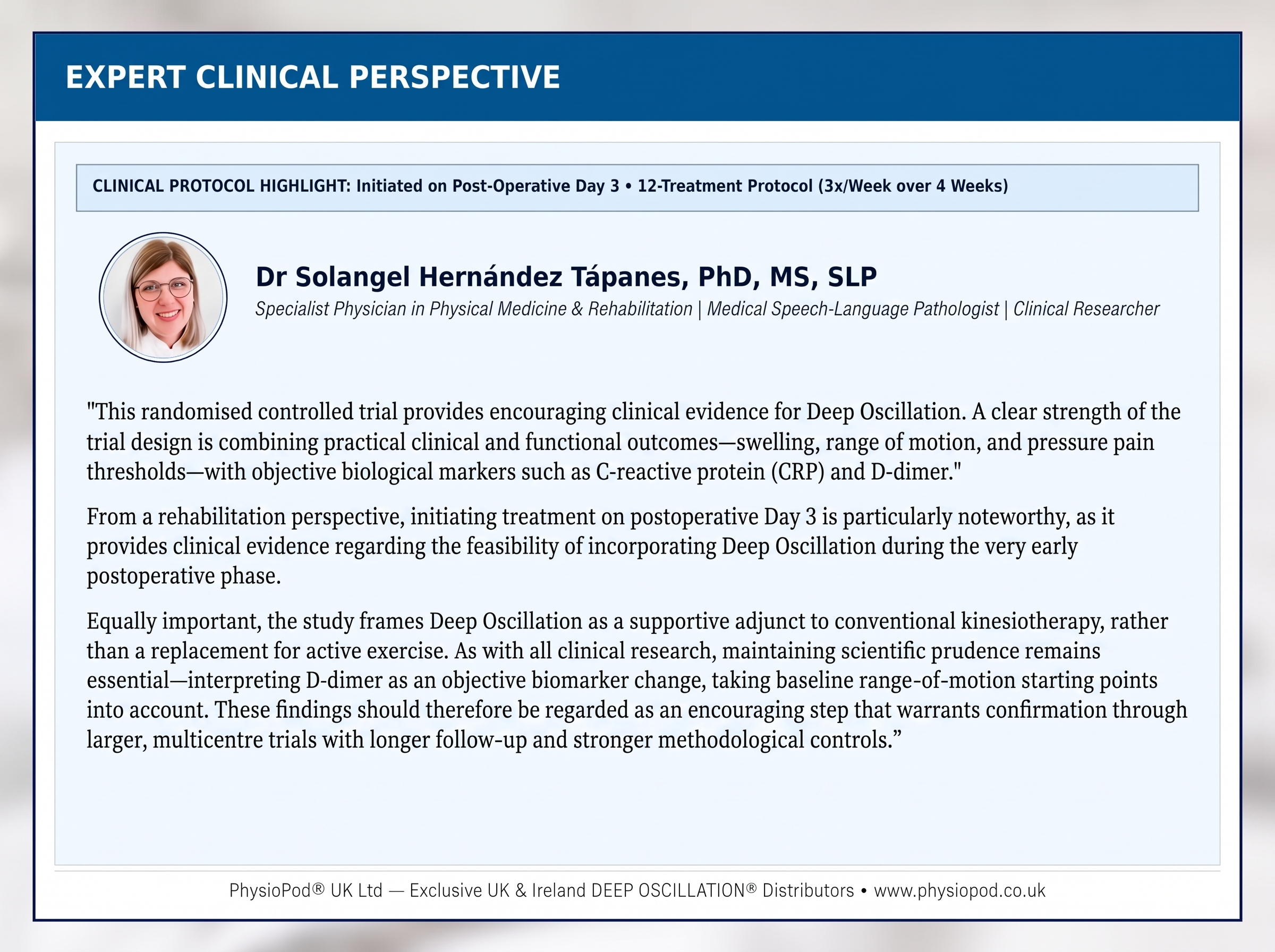
Treatment was initiated on post-operative Day 3 and delivered three times weekly across the four-week study period (12 sessions in total).
Deep Oscillation was delivered using a professional CE-certified console (Physiomed Elektromedizin AG, Germany). Treatments were applied directly by trained physiotherapists using a handheld 9.5 cm circular applicator head moving smoothly across the knee skin, paired with a passive neutral electrode held in the patient's hand.
Each 40-minute session was split into two 20-minute segments (20 minutes on the anterior knee in a supine position, and 20 minutes on the posterior knee in a prone position), stepping through a three-stage frequency sequence:
10 minutes at 120–180 Hz (high-frequency initial tissue relaxation and fluid mobilisation)
5 minutes at 14–30 Hz (low-frequency deep tissue interaction and softening)
5 minutes at 85 Hz (mid-range frequency consolidation)
2. The Control Protocol (Standard Kinesiotherapy Alone)
Both groups completed an identical 4-week post-operative kinesiotherapy programme consisting of:
- Progressive active and passive range-of-motion (ROM) exercises
- Self-assisted isometric quadriceps contractions
- Manual patellar (knee cap) and scar tissue mobilisation
- Gait re-education and crutch weight-bearing progression
- Proprioceptive and balance training
Clear Clinical Outcomes at 4 Weeks
By the end of the 4-week trial, patients receiving Deep Oscillation achieved faster, statistically significant improvements across all primary clinical and biological endpoints (p < 0.01):
- More Than Double the Swelling Reduction: Knee joint circumference decreased by nearly 5 cm in the Deep Oscillation group compared to 2 cm in the control group (−4.98 cm vs −2.09 cm).
- Full Leg Straightening Restored: The treatment group reached full knee extension (0° deficit) within 4 weeks, whereas the control group retained a persistent 5.67° extension deficit.
- Greater Knee Flexion: Active knee bend reached over 92° in the treatment group compared to 53.8° in the control group (92.83° vs 53.83°).
- Doubled Pressure Pain Tolerance: Mechanical pressure pain threshold more than doubled (44.17 N vs 21.37 N), allowing patients to engage in active rehabilitation exercises with significantly less discomfort.
- Steeper Inflammatory Clearance: Blood testing revealed systemic C-reactive protein (CRP) dropped nearly 4 times lower in the treatment group (1.84 µg/ml vs 7.26 µg/ml), alongside lower thromboembolic risk markers (D-Dimer: 138.90 µg/ml vs 290.85 µg/ml).
Methodological Limitations to Consider
To maintain rigorous scientific transparency, the authors noted several study limitations:
- Sample Size & Single Centre: The study evaluated 60 participants at a single orthopaedic rehabilitation centre, which may limit generalisability across broader patient populations.
- Unblinded Design: Neither participants, physiotherapists, nor outcome assessors were blinded to group allocation.
- Short-Term Time Horizon: Outcome data was collected over the initial 4-week post-operative window; long-term functional stability, graft survival, and return-to-sport metrics were not tracked.
- Absence of Imaging & PROMs: Patient-reported outcome measures (PROMs) and objective structural imaging (such as MRI or ultrasound) were not included in the primary trial design.
Clinical Summary & Takeaway
Classified as Oxford Level 2 Evidence, this trial demonstrates that incorporating non-invasive, low-intensity Deep Oscillation into early ACL rehabilitation offers a gentle, effective way to reduce joint swelling, relieve pain, and restore early joint extension without applying painful mechanical load to healing tissue.
- Title: Effect of Deep Oscillation Therapy on Early Rehabilitation Outcomes Following Anterior Cruciate Ligament Reconstruction: A Randomised Controlled Trial
- Authors: Dr Katarzyna Oestervemb, Dr Robert Trybulski, et al. (2025)
- Journal: Journal of Rehabilitation Medicine
- Indexing: View Official Abstract & Trial Data on PubMed (Opens in new tab)
