
Am I Included or Merely Invited? By Fiona (Fee) Stevenson – Disability Advocate and Speaker
Why accessibility must be more than a promise at conferences and events.
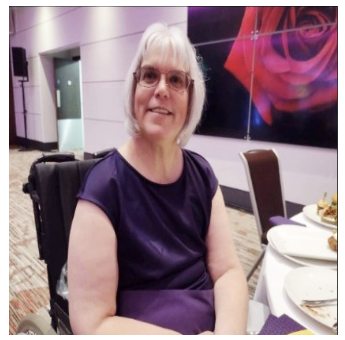
Fiona (Fee) Stevenson, Disability Advocate and Speaker
As a disability advocate, wheelchair user and professional speaker, I attend conferences, networking events and professional development opportunities.
These should be occasions to learn, share experiences, make connections, develop professionally and, importantly, enjoy ourselves.
However, over the years, I have experienced situations that have made me question something fundamental:
Am I genuinely included, or am I simply invited?
I spend considerable time educating organisations about disability awareness, accessibility and inclusion.
Yet sometimes I encounter the very barriers I work so hard to help others understand.
This article is not about identifying or criticising any particular organisation, conference or venue.
It is about learning from lived experiences, challenging assumptions and encouraging positive change.
Because being welcomed through the door is not the same as being included once you're inside.
When attending an event becomes a safety concern
My manual wheelchair is individually fitted to support my physical needs, including protecting my spine.
It is not simply somewhere for me to sit. It provides essential postural support, mobility and independence.
When someone knocks into, kicks, grabs or leans against my wheelchair, even accidentally, the impact can cause considerable physical pain.
Unfortunately, these are not isolated experiences.
Over the years, I have encountered situations where a lack of awareness, insufficient space or thoughtless behaviour has compromised my safety.
This raises an uncomfortable question.
Should disabled delegates have to reconsider attending events because the environment or behaviour of others puts them at risk?
Sometimes people express genuine concern for our wellbeing and suggest that avoiding particular situations might be safer.
I understand that concern. It often comes from kindness.
But surely the better question is:
What can we change to make participation safer?
Improving attitudes and organisational cultures may take time. However, practical improvements can begin immediately.
Adequate circulation space, thoughtful room layouts, disability awareness and clear expectations about respecting mobility equipment can all make a difference.
My wheelchair is an extension of my personal space.
Please don't touch, move, lean on or push someone's wheelchair without their permission.
And remember that an accidental collision can have consequences far beyond a momentary inconvenience.
Accessibility begins long before the event
Accessibility should never be something organisers think about only when a disabled delegate arrives.
It begins with choosing the venue, planning the programme, designing registration forms and considering how people will move around the building.
An accessible entrance doesn't automatically make a venue accessible.
Can wheelchair users move independently between conference rooms, dining areas and exhibition spaces?
Are ramps safe, appropriately designed and manageable?
Can people open doors without assistance?
Are accessible toilets genuinely accessible, clean, maintained and free from obstructions?
Are emergency assistance cords reachable, functioning and understood by staff?
Are accessible bedrooms suitable for the individual rather than simply labelled as accessible?
A venue may advertise accessible facilities, but accessibility needs to work in practice, not just on paper.
Organisers should carry out meaningful accessibility assessments and, wherever possible, involve people with lived experience.
Don't just ask whether a venue is accessible.
Ask who it is accessible for, and how that has been established.
Hearing loops, captions and communication access
Accessibility is not solely about physical mobility.
Some delegates are deaf or hard of hearing. Others experience auditory processing difficulties, sensory impairments or conditions that affect their ability to follow spoken presentations.
Hearing loops and other appropriate assistive listening systems should be available where needed, tested before the event and clearly advertised.
Captions should also be considered as part of accessible event planning, rather than an unexpected request that has to be negotiated at the last minute.
One principle I feel particularly strongly about is this:
A delegate's communication access should not depend on whether an individual speaker personally agrees to provide it.
Organisers should establish accessibility expectations with speakers in advance and arrange appropriate captioning or other communication support.
Speakers have a role in supporting accessibility, but the responsibility for ensuring delegates can access an event should not be passed from one person to another.
Captions can benefit many people, including those who struggle with accents, unfamiliar terminology or background noise.
Accessible communication benefits the whole audience.
And let's remember that some people may need information in large print, accessible digital formats or other alternatives.
If someone cannot access what is being said, how can they fully participate?
Dietary requirements are not an optional extra
Food is another area where inclusion can fall short.
Delegates may have allergies, intolerances, medical conditions, religious requirements or other dietary needs.
When organisers ask about dietary requirements during registration, there is a reasonable expectation that those needs will be communicated and accommodated appropriately.
Imagine attending a full-day conference, participating in workshops, networking and presentations, only to discover that there is nothing suitable for you to eat.
Now imagine managing a medical condition or chronic fatigue alongside that.
Being left without an appropriate meal can affect someone's health, energy and ability to participate.
Organisers should communicate clearly with caterers, confirm that suitable food will be available and ensure staff understand how to identify and serve the correct meals.
For allergies, appropriate food safety procedures and accurate information are essential.
And if something goes wrong, there should be a practical solution rather than leaving the delegate to manage alone.
If you ask people about their dietary requirements, please act on the information they provide.
Emergency evacuation must include everyone
Emergency planning is another essential part of accessibility.
What happens if the fire alarm sounds?
Can everyone hear it?
What arrangements exist for someone who is deaf or hard of hearing?
Are visual alarms, vibrating alerts or other appropriate notification systems available?
What happens to someone who cannot use stairs?
Who knows what assistance may be needed, and how will it be provided safely?
Personal Emergency Evacuation Plans (PEEPs), where appropriate, should be meaningful and developed with the individual.
They should not be treated as paperwork completed simply to satisfy a procedure.
Emergency arrangements must also be communicated to the relevant staff and tested where appropriate.
An accessible room or conference space is not truly inclusive if someone cannot be alerted to an emergency or evacuate safely.
Accessibility doesn't stop when the fire alarm sounds.
Disability awareness is everyone's responsibility
I frequently encourage people to look beyond the wheelchair.
Disability is diverse, and many conditions are not immediately visible.
Someone may be managing chronic pain, fatigue, hearing loss, sensory difficulties, a neurological condition or another disability that others cannot see.
We should never assume that because someone appears to be coping, they are not struggling.
Nor should disabled delegates be expected to spend their entire conference explaining their needs, correcting misconceptions or educating people about basic disability etiquette.
Event organisers, venue staff, volunteers, exhibitors, speakers and delegates all have a part to play.
Simple actions make a difference.
Ask before offering physical assistance.
Respect mobility equipment and personal space.
Speak directly to the disabled person rather than automatically addressing someone accompanying them.
Ensure pathways remain clear and don't assume that everyone can stand for long periods, climb steps or navigate crowded rooms.
Ensure pathways remain clear and don't assume that everyone can stand for long periods, climb steps or navigate crowded rooms.
Most importantly, listen when someone explains what they need.
Disability awareness is not about treating people differently. It is about understanding what enables people to participate equally.
The emotional impact of inaccessible events
We often discuss accessibility in terms of ramps, lifts, toilets and equipment.
But we don't always talk about the emotional consequences when things repeatedly go wrong.
Imagine arriving at an event looking forward to learning and meeting people, only to find yourself worrying about whether you can safely move around, use the facilities, access presentations or eat a suitable meal.
Imagine missing sessions because you're trying to resolve an accessibility problem.
Or feeling exhausted because you've had to spend so much energy advocating for yourself.
Repeated barriers can gradually take away the enjoyment of attending.
They can leave people feeling frustrated, disappointed, anxious or excluded.
Sometimes the people around us become concerned for our safety and wellbeing.
Their concern may be entirely genuine and well-intentioned.
But it raises another important question.
When disabled people begin questioning whether they should attend events at all, are we recognising the impact of repeated accessibility failures?
Nobody should feel that staying away is the only way to remain safe.
What can conference organisers do differently?
I don't expect every event to be perfect.
Challenges arise, mistakes happen and some improvements require investment or longer-term planning.
But meaningful inclusion requires action, not simply good intentions.
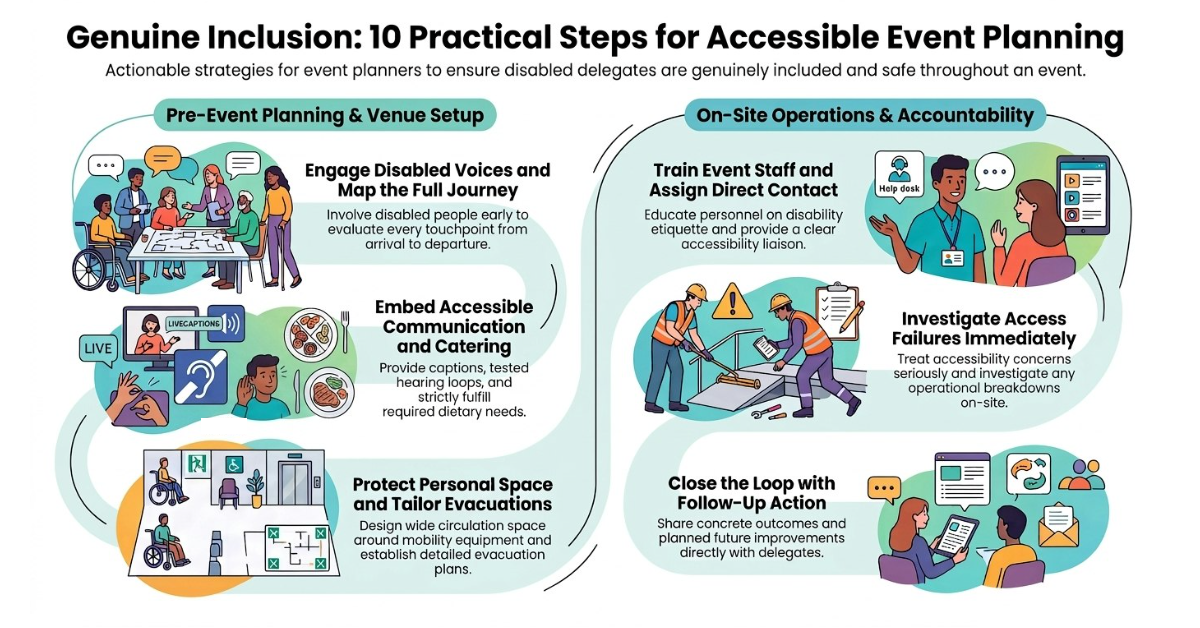
Here are ten practical steps organisers can take:
1. Involve disabled people early. Seek lived experience when selecting venues, planning layouts and designing the event.
2. Assess the entire delegate journey. Consider arrival, registration, presentations, networking, dining, accommodation, toilets and departure.
3. Make communication accessible. Arrange appropriate captions, hearing support, accessible materials and clear signage.
4. Meet dietary requirements. Confirm arrangements with caterers and have a contingency plan when something goes wrong.
5. Protect personal space and mobility equipment. Provide adequate circulation space and promote respectful behaviour.
6. Plan emergency arrangements. Consider different disabilities, accessible alarms, individual evacuation needs and staff responsibilities.
7. Train staff and volunteers. Ensure they understand disability awareness, appropriate assistance and how to respond to problems.
8. Provide a clear point of contact. Delegates should know whom to approach when accessibility arrangements fail.
9. Take concerns seriously. Record incidents, investigate what happened and identify practical improvements.
10. Close the feedback loop. Tell delegates what has been learnt, what will change and when improvements will be implemented.
Accessibility should not depend upon whether a particular disabled delegate happens to be attending.
It should be embedded in the planning and delivery of every event.
Inclusion is more than good intentions
I have met many wonderful people through conferences and professional events.
People who genuinely care, offer support, value different perspectives and want everyone to feel welcome.
Their kindness matters enormously.
But kindness alone cannot replace accessible facilities, safe environments, appropriate communication support and effective planning.
An organisation can sincerely value disabled people while still having accessibility arrangements that need improvement.
Recognising that isn't an attack.
It's an opportunity to learn and do better.
As a disability advocate, my aim is not to criticise individuals but to help organisations understand how seemingly small barriers can have significant consequences.
I want people to ask questions, challenge assumptions and recognise that inclusion is something we demonstrate through our actions.
Not simply something we write in a policy or promote on a website.
Am I included or merely invited?
That question is not just about my experiences.
It applies to anyone who has attended an event and felt that their needs were overlooked.
The wheelchair user who cannot move safely through a crowded room.
The deaf delegate who cannot follow a presentation because captions or hearing support are unavailable.
The person with dietary requirements who discovers there is nothing suitable to eat.
The individual with a hidden disability who becomes exhausted trying to navigate an inaccessible environment.
The delegate who worries about what would happen during an emergency.
All of these people may have received an invitation.
But were they genuinely included?
True inclusion means being able to participate safely, independently, equally and with dignity.
It means being able to focus on the reason you attended, rather than spending your time overcoming avoidable barriers.
It means listening to concerns, learning from mistakes and making improvements that benefit everyone.
I want conferences to be places where people feel valued, respected and safe.
Where disability is not treated as an inconvenience.
Where access needs are anticipated rather than questioned.
And where nobody feels that their safest option is to stay away.
So, to every conference organiser, venue, speaker and event professional, I leave you with this thought:
Don't just invite us to the table. Make sure we can reach it, hear what's being said, eat what's provided and leave safely.
Because that is the difference between being invited and being truly included.
